Amulet: on-chain vault management for fund managers and investors
Amulet connects professional fund managers with investors through curated smart-contract vaults: yield strategies on audited DeFi protocols, RWA-backed treasury products, and the operational layer to run them. Physical-asset tokenization (hotels, yachts, property turned into on-chain positions) is one use case within the same platform, where every vault is a public contract with verifiable NAV, fees and redemption rights. The client arrived with the idea and nothing to build it with. bytehive built the whole thing, and defined the product while doing it.
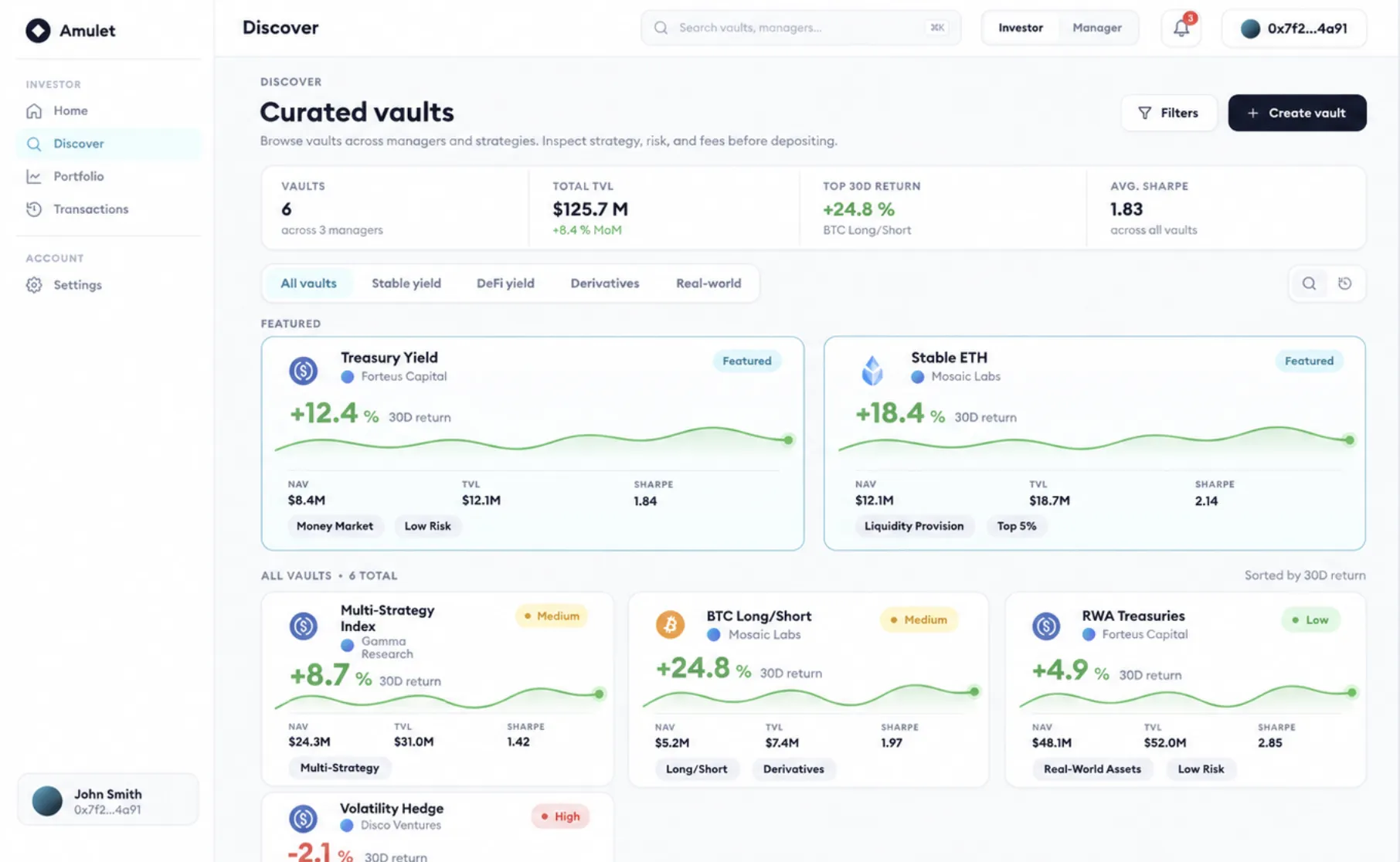
Discover lists curated on-chain vaults by strategy and risk, from DeFi yield to RWA treasuries, with live TVL, NAV and performance for each manager.
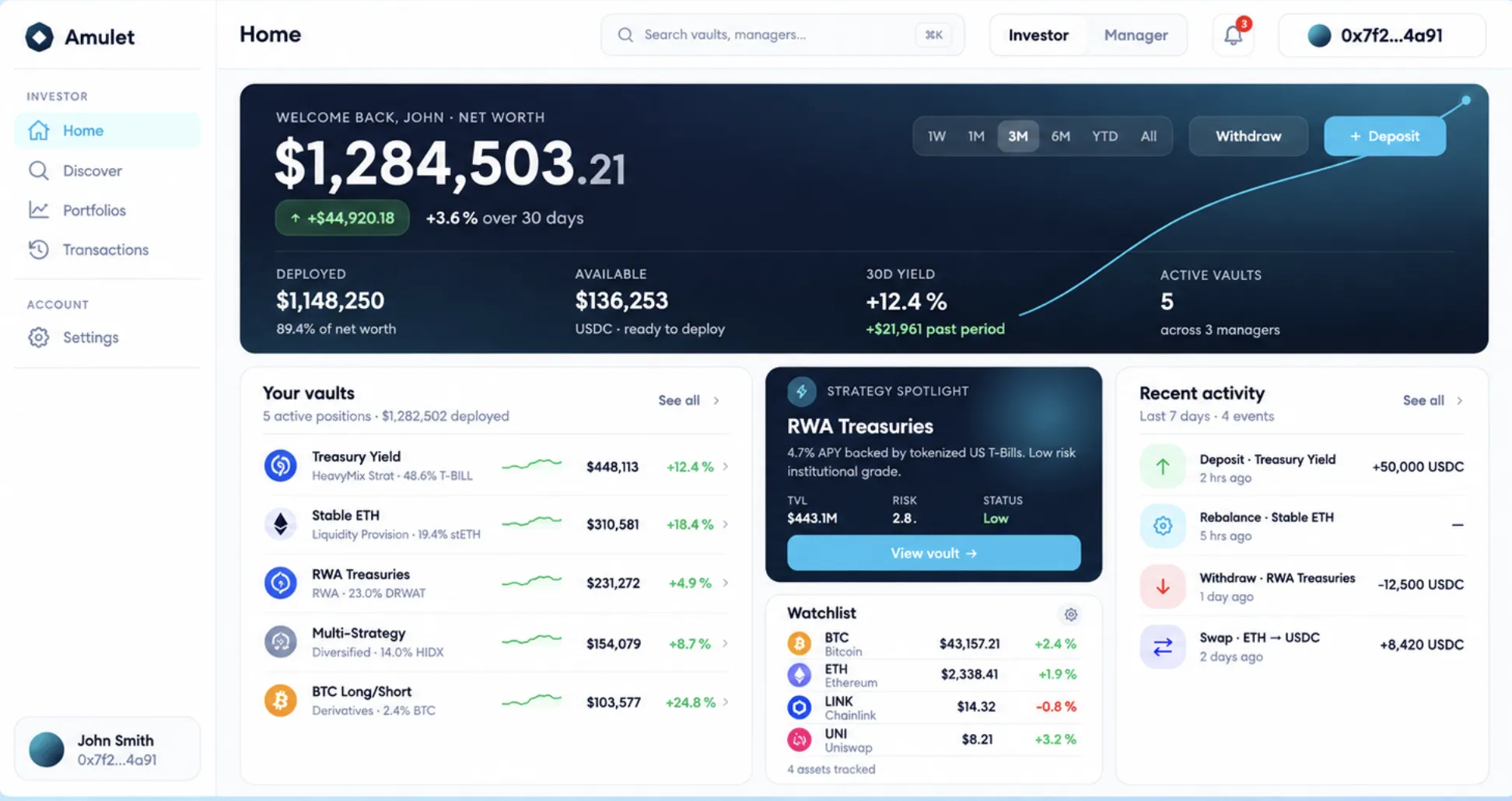
The investor home screen tracks net worth, vault positions and recent deposits and rebalances, with RWA treasury strategies alongside DeFi allocations.
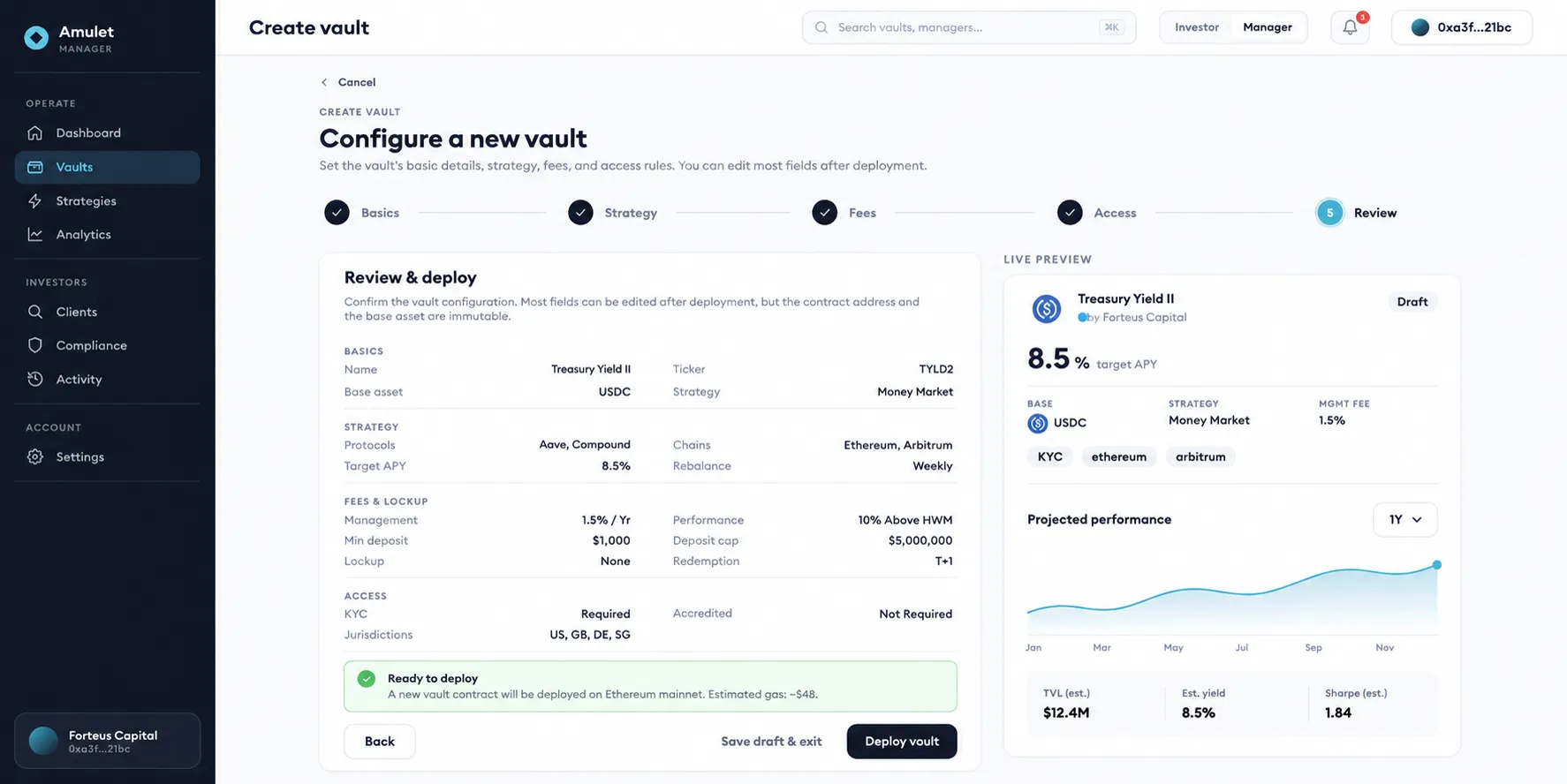
A five-step wizard configures strategy, fees, access rules and jurisdictions, then previews the listing and deploys a new vault contract on-chain.
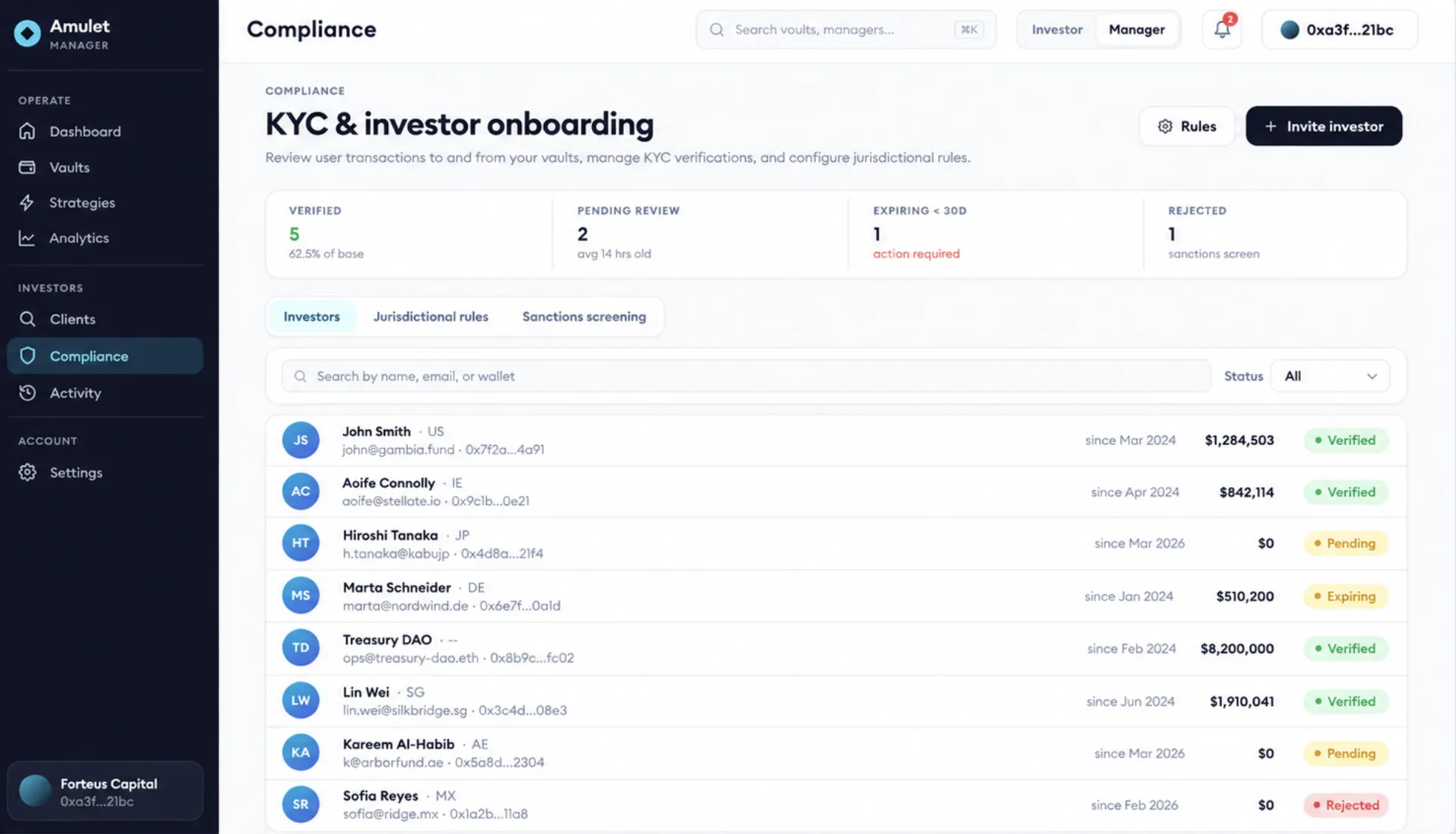
The compliance workspace reviews KYC status, sanctions screening and jurisdictional rules for every wallet depositing into a manager’s vaults.
- On-chain asset management and real-world asset tokenization
- The full cycle in house: product definition, AI prototyping, full-stack development, QA and project management
- A React application on Vite with a multi-wallet Web3 layer
Physical-asset tokenization (someone owns a hotel, a yacht, a restaurant, an apartment block, and that ownership becomes tokens investors can buy whole or in slices) is one use case within a broader on-chain asset-management platform. Its smart-contract-vault surface lets professional managers run curated strategies while investors discover, deposit into and redeem from them with positions, NAV and fees verifiable on-chain. RWA treasury vaults sit in the same marketplace as DeFi yield strategies.
We did not take a specification and return an application. We took the product itself: what it should be for a fund manager configuring a vault and for an investor browsing strategies, and then the whole build, with QA and project management on our side too. One team, thinking about the product as its own.
The platform serves two sides. Investors browse curated vaults across risk profiles (stable money-market yields, cross-chain liquidity, RWA treasuries) and track net worth, deposits and rebalances from one dashboard. Managers get vault creation and deployment, real-time performance analytics, client relationship management and a built-in compliance layer covering KYC screening, sanctions checks and jurisdiction-specific gating.
The wallet layer deserves its own line. Multi-wallet connection, the security work around it, and every one of those connections tested by hand across the wallet landscape. On a platform where the wallet is how an investor holds a position, someone who cannot connect the one their money already sits in cannot use the product at all.
An on-chain asset-management platform taken from an idea to a working product by one team that also defined it, spanning investor marketplace, manager operations, vault deployment and compliance.
The contracts underneath are not ours. bytehive integrates against on-chain protocols rather than authoring or auditing them, which is the honest line and the one that makes the rest of this credible.